
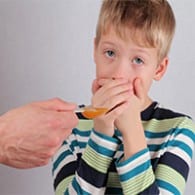
Giving Medicines
As Mary Poppins sings, “A spoonful of sugar helps the medicine go down.” Giving medicine to children may require an additional measure of creative marketing as the finishing touch. Try these tricks:
Match the Medicine to the Mouth
The same medication may come in a variety of flavors and forms. Stick to your baby’s preferences. Generic brands may have a harsher taste.
Try Magic Paste
Most babies prefer liquid, but if your baby is a spitter or a sprayer, ask your doctor if the medication comes in a chewable tablet form. Crush the tablet between two spoons and add a drop or two of water to make a thick paste. Apply a little bit (a fingertipful) of the paste at a time to the inside of your baby’s cheek, and it will be swallowed without a struggle. The flavor of chewable tablets is usually more pleasant. This is even true of acetaminophen.
Make a Cheek Pocket
This is our family secret for giving medicine to children who are veteran spitters. Be sure you have the medicine within reach and ready to go before you start this procedure! Cradle the baby’s head in the crook of your arm. With the same hand, encircle baby’s cheek and use your middle or index finger to pull out the corner of his mouth, making a pocket in his cheek. With the other hand drop the medicine into this cheek pocket a little at a time. This hold keeps baby’s mouth open and his head still. Best of all, the traction on baby’s cheek with your finger keeps him from spitting the medicine back out. Maintain the traction until all the medicine has gone down. Necessity is the mother of invention, or in this case the father. I discovered this technique when Martha, the queen medicine-giver in our family, left me alone at medicine time with eighteen-month-old Stephen.
Use the Art of Camouflage
You can bury a crushed pill in a sandwich – jam it into the jam, place the paste under the peanut butter – or chase it with a small amount of milk, formula, or juice. Make the medicine as palatable as possible without fibbing that the medication is “candy.”
Try Spoons, Droppers, and Other Medicine Helpers
A shallow plastic medicine teaspoon (calibrated and available at pharmacies) is easier to use than a teaspoon. To wipe the remaining medicine from the spoon, use the upper lip sweep, sweeping the bowl against the inside of your baby’s lip as you pull the spoon from your baby’s mouth. A calibrated medicine dropper inserted into the side of baby’s mouth, between cheek and gum, is a proven medicine-giving aid. Squirt in a few drops at a time in between swallows. Some babies accept medicines best from a tiny plastic cup, which can also be used to catch and recycle the dribbles.
Aim Wisely
Try to avoid sensitive areas in the mouth. The taste buds are concentrated toward the front and center of baby’s tongue. The roof of the mouth and the back of the tongue are gag-sensitive areas. Best is the side pocket between gum and cheek, to the rear of the mouth.
What if baby spits up the medicine?
The intestines absorb most medications within a half-hour to forty-five minutes. If your baby has retained the medicine that long, it is usually unnecessary to make up the dose. However, we always advise calling your doctor’s office if your baby spits up a prescription medication.
Sometimes a baby is too sick to retain oral medicine and spits up every dose. This is common with oral fever medications, such as acetaminophen. In this case, consider talking to your child’s doctor about using the fever-lowering medicine in suppository form. Also, your doctor may prescribe an anti-vomiting suppository to be given twenty to thirty minutes before an oral dosage, which may help the oral medicine stay down.
Compounding the Medication
These days, many pharmacies are able to compound certain prescription medications. If you are given a prescription and you know your child may struggle with the taste, your pharmacy may be able to compound the prescription with a more palatable formulation. Talk with your child’s doctor about Pediatric Compounding Pharmacies in your area.