
AskDrSears Logo
homeabout searsbooksnewsletterfaqsresourcesnewsstorecontact us
what's newregular featurespediatric newsDoctor's Diaries


Search


pregnancy & childbirth
breastfeeding
bottlefeeding
feeding infants & toddlers
family nutrition
discipline & behavior
fussy babies
sleep problems
childhood illnesses
medicine cabinet
a to z index
GoFish Omega 3 DHA Attachment Parenting Vaccines Lean Skin Care


Feeding Infants and Toddlers

STARTING SOLID FOODS
Topics you will find:

6 Reasons to Wait
Frequently Asked Questions About Solid Foods

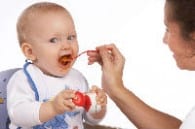
Ready to open your baby's mouth to a whole new world of textures and tastes? Is baby ready to open her mouth? Get ready for the joys – and the mess – of eating solid foods. When you begin feeding your baby solid foods you want to progress in a way that sets baby up for healthy eating habits. You are not only putting food into your baby's tummy, you are introducing lifelong attitudes about nutrition. Consider for a moment that during the first year or two you will spend more time feeding your baby than in any other interaction. You both might as well enjoy it.

WHY WAIT? 6 REASONS

Gone are the days when pressured mothers stuffed globs of cereal into the tight mouths of reluctant six-week-olds. Nowadays parents feed their baby on the timetable that is developmentally and nutritionally correct -- as determined by their baby. Don't be in a rush to start solids. Here are some good reasons for waiting.

1. Baby's intestines need to mature. The intestines are the body's filtering system, screening out potentially harmful substances and letting in healthy nutrients. In the early months, this filtering system is immature. Between four and seven months a baby's intestinal lining goes through a developmental growth spurt called closure, meaning the intestinal lining becomes more selective about what to let through. To prevent potentially-allergenic foods from entering the bloodstream, the maturing intestines secrete IgA , a protein immunoglobulin that acts like a protective paint, coating the intestines and preventing the passage of harmful allergens. In the early months, infant IgA production is low (although there is lots of IgA in human milk), and it is easier for potentially-allergenic food molecules to enter the baby's system. Once food molecules are in the blood, the immune system may produce antibodies to that food, creating a food allergy . By six to seven months of age the intestines are more mature and able to filter out more of the offending allergens. This is why it's particularly important to delay solids if there is a family history of food allergy, and especially to delay the introduction of foods to which other family members are allergic.

2. Young babies have a tongue-thrust reflex . In the first four months the tongue thrust reflex protects the infant against choking. When any unusual substance is placed on the tongue, it automatically protrudes outward rather than back. Between four and six months this reflex gradually diminishes, giving the glob of cereal a fighting chance of making it from the tongue to the tummy. Not only is the mouth-end of baby's digestive tract not ready for early solids, neither is the lower end.

3. Baby's swallowing mechanism is immature. Another reason not to rush solids is that the tongue and the swallowing mechanisms may not yet be ready to work together. Give a spoonful of food to an infant less than four months, and she will move it around randomly in her mouth, pushing some of it back into the pharynx where it is swallowed, some of it into the large spaces between the cheeks and gums, and some forward between the lips and out onto her chin. Between four and six months of age, most infants develop the ability to move the food from the front of the mouth to the back instead of letting it wallow around in the mouth and get spit out. Prior to four months of age, a baby's swallowing mechanism is designed to work with sucking, but not with chewing.

4. Baby needs to be able to sit up. In the early months, babies associate feeding with cuddling. Feeding is an intimate interaction, and babies often associate the feeding ritual with falling asleep in arms or at the breast. The change from a soft, warm breast to a cold, hard spoon may not be welcomed with an open mouth. Feeding solid foods is a less intimate and more mechanical way of delivering food. It requires baby to sit up in a highchair – a skill which most babies develop between five and seven months. Holding a breastfed baby in the usual breastfeeding position may not be the best way to start introducing solids, as your baby expects to be breastfed and clicks into a "what's wrong with this picture?" mode of food rejection.

5. Young infants are not equipped to chew. Teeth seldom appear until six or seven months, giving further evidence that the young infant is designed to suck rather than to chew. In the pre-teething stage, between four and six months, babies tend to drool, and the drool that you are always wiping off baby's face is rich in enzymes, which will help digest the solid foods that are soon to come.

6. Older babies like to imitate caregivers. Around six months of age, babies like to imitate what they see. They see you spear a veggie and enjoy chewing it. They want to grab a fork and do likewise.

As with all aspects of parenting, watch your child and not the calendar. Besides the developmental milestones above, watch for these ready-to-eat cues in your baby:

  • Able to sit with support, reaches and grabs, and mouths hands and toys
  • Watches you eat, following your fork as it moves from plate to mouth
  • "Mooches," reaching for food on your plate
  • Mimicks your eating behaviors, such as opening her mouth wide when you open your mouth to eat. Grabbing your spoon is not a reliable sign of feeding readiness, since baby may be more interested in the noise, shape, and feel of your utensils rather than the food stuff on them.
  • Baby can show and tell. Around six months of age babies have the ability to say "yes" to wanting food by reaching or leaning toward the food and "no" by pushing or turning away. Expect mixed messages as your baby learns to communicate. When in doubt, offer, but don't force.

Does baby seem hungry for additional food? If your baby is content with breastmilk or formula, no need to complicate his life with solids. If, on the other hand, your baby seems unsatisfied after a feeding, is shortening the intervals between feedings, and several days of more frequent feedings don't change this, it may be time to begin.

I'm not sure if my baby is ready. Should I try offering solids anyway?Is your baby both ready and willing to try solid foods? Here's how to tell. If your baby eagerly opens his mouth when he sees a spoonful of food coming toward him, he is probably both ready and willing. If he turns away, he's not. Or, give him a spoon to play with to see if it quickly ends up in his mouth. (Feeding tip: use plastic spoons with smooth, rounded edges. They do not get too cold or hot, and they are quiet when banged or dropped.) Remember, your immediate goal is to introduce your baby to solid foods, not fill him up on solids. Milk feedings will continue to be a major part of his diet for the next several months. Gradually introduce baby to a different texture, taste, and way of swallowing. Overwhelming your child with big globs of too many new foods all at once invites rejection. At this point, solids are add-ons, not substitutes for the breast or bottle. However, if you have a six- to nine-month-old formula-fed baby who is taking forty ounces a day, you may consider substituting a solid food feeding for a bottle.

When your child is older and eating solid food, make sure they are getting enough of the essential vitamins and nutrients by giving them fruit based Little Champions Multivitamins.

NUTRITIP: Favorite First Foods

  • rice cereal
  • peaches
  • barley cereal
  • applesauce
  • bananas
  • carrots
  • pears
  • squash
  • avocados
  • sweet potatoes
  • Begin with foods that are not likely to cause allergies and that are most like the milk baby is used to. If your baby is used to the sweet taste of human milk, start with mashed bananas. If baby is used to the more bland flavor of formula, try rice cereal mixed with formula (or with your milk if your breastfed baby prefers rice cereal to bananas). Rice is the most intestinal-friendly grain because it is gluten-free, low in protein, and high in carbohydrates. It has a nutritional profile more like a fruit than a grain. Mix the cereal to a soupy consistency and lessen the amount on milk or formula you add as baby gets better at eating.

    Use your finger as baby's first "spoon." It's soft, at the right temperature, and baby is familiar with it. Encourage baby to open her mouth wide. Place a fingertipful of this glorious glob on baby's lips while letting her suck on the tip of your finger. Next, advance the fingertipful of food to the tip of your baby's tongue (where there are tastebuds receptive to sweetness). If this gets swallowed, or at least is not spit back at you, try placing the next glob toward the middle of baby's tongue.

    Watch baby's reaction to this new experience. If the food goes in with an approving smile, baby is ready and willing. If the food comes back at you, accompanied by a disapproving grimace, baby may not be ready. Some babies make funny faces just because this is all so new to them. What happens in the mouth may be a more accurate indicator of whether a baby is ready to eat solids. If the mouth opens for a second helping, give it another try – you may have a winner. Even if the food comes back out, the baby may just need to learn to seal his mouth shut when he moves the food from the front to the back. Rejection of the food could also indicate that the tongue-thrust reflex is not yet gone, and baby can't move the food to the back of his mouth and swallow it. If your baby just sits there, with an open mouth, confused by the glob of food perched on her tongue, she's probably having difficulty with the tongue-thrust reflex. Let her practice a while. If she still doesn't seem to know what to do, wait a week or two before you try again.

    NUTRITIP: First Spoon

    We advise that baby's first "spoon" be your finger. It is soft, at the right temperature, and by this stage baby is very familiar with its feel. Your finger also knows if food is too hot. Few babies like to begin their feeding life with a silver spoon in their mouth. Metal holds the heat in, so baby has to wait longer for each bite as you cool the hot food by blowing on it. A hungry baby finds this infuriating! A coated demitasse spoon is a good starter utensil. Plastic spoons with smooth, rounded edges are best – and quietest when banged or dropped. Use shatterproof plastic bowls that can survive battering on the high-chair tray and numerous tumbles to the floor.

    If your baby eagerly accepts the first fingertipful of food, offer a little more the next time. At these first feedings, baby may actually swallow only a teaspoon or two of food. Gradually increase the amount you give baby until you are offering a quarter-cup or more at a time. Remember, your initial goal is to introduce your baby to the new tastes and textures of solid foods, not to stuff baby. As with all areas of development, babies take two steps forward and one step back. Expect erratic eating patterns. Baby may take a couple tablespoons one day and only a teaspoon the next. Baby may devour pears and refuse bananas one day, then the next day ignore the pears and gobble down the banana. That's all part of the feeding game. Relax and realize that you can't control your child's every mouthful. Don't force-feed a baby. Know when enough is enough. (Your baby knows.) Observe stop signs:

    • Baby purses lips, closes mouth, and turns head away from approaching spoon.
    • Baby leans away from the advancing spoon, uninterested or wanting to avoid the food entirely.
    • Leaning toward the food or grabbing the spoon or hand of the feeder indicates a desire for more.

    NUTRITIP: Milk Plus

    Consider solid foods an addition to, not a substitute for, breastmilk or formula, which are more nutritionally balanced than any solid food. This food fact is especially important for breastfeeding babies. For a breastfeeding baby, it's best to start solids slowly, so that they don't become a substitute for the more nutritious breastmilk. Also, solids fed at an early age can interrupt the supply-and-demand cycle, resulting in decreased milk production.

    Offer new foods in the morning. If by some chance your baby is allergic to a particular food, the intestinal upset should wear off by the end of the day. Beginning a new food in the evening runs the risk of painful nightwaking. Otherwise, offer solids at the time of the day when your baby seems hungriest, is bored, or you both need a snack and something interesting to do. Mornings are usually the time when babies are hungriest and in the best mood for social interactions, including feeding.

    If breastfeeding, try offering solid foods toward the end of the day, when your milk supply is likely to be the lowest and baby will be more eager to eat. Feed baby solids between breastfeedings, not right after, since solid foods may interfere with the absorption of some of the nutrients in breastmilk.

    Choose a time of the day when you are not in a hurry, since dawdling, dabbling, spewing, spattering, smearing, and dropping are all part of the feeding game. Forget fast-feeding. Remember, meals are both a food-delivery system and a social experience. Take your time, and enjoy this new nutritional stage.

    Work your way from soupy to lumpy as you also increase how often and how much baby eats. At first, you'll offer food only once a day; but within a few months, you'll be feeding solids whenever you sit down to a meal. Babies differ so much in their preferences and their readiness for solids that it's difficult to make hard and fast rules about the consistency, amount, and type of solid foods to offer. But here are some suggestions from our family and our pediatric practice for babies from five to eight months.

    Bananas. Because of their sweetness and smooth consistency, ripe bananas closely resemble mother's milk, which makes them an ideal starter food. They are one of the few fruits that can be served uncooked. Let the banana get very ripe before serving it to baby (the skin should be covered with brown spots). After peeling, cut and mash it with a fork, and serve it either straight or mixed with formula or breastmilk for a more soupy consistency. Bananas are a great quick meal for parents and babies on the go -- mash a few slices and eat the rest yourself.

    Cereal. Begin with rice or barley cereal, the least allergenic. Don't serve a mixed cereal until you've tried each of the ingredients separately to be sure baby is not allergic to any of them. Rice is approximately 75 percent carbohydrates and seven percent protein. High protein cereals, made primarily with soybeans, may contain as much as 35 percent protein. Cereals made especially for infants are fortified with minerals, such as calcium and phosphorus, along with B-vitamins and iron. Begin with one- fourth teaspoon of cereal and advance to a tablespoon, and so on. Mix it with breastmilk or formula to the desired consistency. Cereal alone is very bland and may be refused by your baby. Once you know your baby is not allergic to different fruits and cereals, you can experiment by combining various fruits with cereal in various consistencies. Cereals are often suggested as a way to fill baby up, lengthening the interval between feedings, and even sleeping longer at night. This "filler fallacy" is an unwise feeding pattern. Cereal is not nearly as nutritious as breastmilk or formula. Besides, this practice rarely works.

    Pears. Pears are easy to digest and have a mild flavor perfect for babies. As with all fruits, they are mostly carbohydrates and a good source of potassium and vitamins A and C. Try pear sauce instead of applesauce.

    Applesauce. Applesauce is an ideal first fruit. It is low in citric acid, which can cause an allergic reaction in some infants. Cook the pared and peeled apples with two tablespoons of water over medium heat until tender. Blend or whip until smooth. Applesauce can be combined with a variety of foods, including cereal or as a "sauce" to disguise less-palatable, but more nutritious, foods. Uncooked apples are difficult for babies to gum and chew under one year of age, and they are a choking hazard.

    Carrots. Cooked carrots are a very good source of vitamin A and beta carotene, and as mom always said, carrots improve night vision. Peel, slice, and steam carrots until tender without spices, salt, sugar, or butter. Small blobs of mashed, cooked carrots are usually well-accepted and enjoyed by babies. Bite-size cooked carrots or a pile of steamed, grated carrots are good finger foods beginning at eight months. Avoid raw carrots, which can cause choking.

    Sweet potatoes and winter squash. Babies enjoy sweet potatoes and winter squash for their flavor, texture, and color. They are both high in beta carotene. Sweet potatoes contain vitamin B- 6, which helps the body use carbohydrates, protein, and fat needed for healthy skin, nerves, and circulation. Winter squash supplies potassium and other nutrients. Carrots, sweet potatoes, and squash can all be cooked quickly in the microwave, with minimum nutrient loss. Sweet potatoes are like convenience foods in the microwave: wash, cook for seven or eight minutes, open and serve. You don't even need a plate. Be sure to stir the warm potato and test for "hot spots," since microwaved food may heat unevenly. Wash and peel sweet potatoes before cooking in a small amount of water, or steam over a medium-heat until tender. Puree with a small amount of liquid. For variety, mix sweet potatoes with peas, carrots, or squash. Cut the squash in half, remove the seeds, and bake it. Or, you can peel it and steam the halves. Blend until smooth and add water to reach the desired consistency.

    Avocados. Avocados are, in our opinion, an ideal food for babies. The avocado's smooth, creamy consistency makes it a fresh fruit even a baby can enjoy. Low in sodium and cholesterol-free, avocados contain such valuable nutrients as vitamin A, vitamin B-6, folic acid, niacin, phosphorus, magnesium, and iron. Ounce-for-ounce avocados contain more potassium than 45 other fruits, juices, or vegetables, including bananas, peaches, carrots, and green beans, and they are one of the only fruits that contain monounsaturated fats, which are essential for your baby's development. Avocados are higher in calories than any other fruit or vegetable. This is a plus for babies, since feeding infants calls for nutrient-dense foods , foods that contain a lot of nutrition per unit of weight and volume. Ripe avocados can be served without any cooking; a time-saver for mom and dad. To prepare, cut in half around the entire circumference of the seed. Grab a half in each hand and twist to remove the seed. Scoop out the meat inside and mash with a fork, or simply spoon-feed directly from the shell. For variety, avocados can be mixed with apple or pear sauce, cooked squash, or sweet potatoes. One of the reasons why avocados are one of the Sears' favorite foods for babies, infants, and children is their versatility. You can do so much with them, as can babies. Avocados can be spread, scooped, mashed, and made into guacamole for children (avocado dip without the strong spices).

    NUTRITIP: Don't Sweat the Small Feedings

    Take it from the Sears family: Relax and have fun with this new stage. By four months of age babies are very astute at reading parents' facial expressions. If you're anxious about getting solid food into your baby, expect baby also to be anxious. Approach the feeding game as just another social interaction that you will both enjoy.

    Purists recommend that vegetables be introduced before fruits so that infants don't learn to expect that food should always taste sweet. This is one of those nutritional directives that sound great in theory, but many of us who have fed lots of babies have found it hard to put into practice. First of all, babies are born with a sweet tooth. Their tiny tongues are more richly supplied with sweet tastebuds than with any others. This makes sense, because human milk is sweet, and breastfed babies are less likely to willingly accept the bland taste of vegetables than formula-fed babies. While there is no doubt that vegetables are nutritionally superior to fruits, most parents find that babies will happily eat fruits, making them hassle-free first foods. The nutritional content of starter foods is of secondary importance; the main goal of these early solid food feedings is for the baby to learn how to swallow foods of different textures. You're likely to have more success with fruits than with vegetables. When introducing veggies, try the sweet ones first: carrots and sweet potatoes. If you have a baby who loves vegetables, good for you! Don't worry if your baby attacks veggies with less enthusiasm than fruit. He'll eventually learn to like them if you keep offering them.

    Begin with single-ingredient foods and space the introduction of each new food at least one week apart. If your baby has a reaction, you'll know what to blame. The most usual signs of food allergy are:

    • bloating and gassiness
    • a sandpaper-like raised red rash on the face
    • runny nose and watery eyes
    • diarrhea or mucousy stools
    • a red rash around the anus (we call this the "target sign.")
    • generally cranky behavior
    • vomiting or increased spitting-up

    If you have a family history of food allergies or are particularly worried about them, keep a food diary, which not only helps you learn your baby's preferences, but helps you be more objective about which symptoms are caused by which foods. As you change the foods that go in one end, expect a change in the color, consistency, and frequency of the waste that comes out the other end. This is normal, and not a sign of food intolerance. You may notice bits of food in baby's stools , or the color may change -- red stools with red vegetables, such as beets, and yellow stools with carrots. Babies who overdose on bananas and/or rice products may become constipated. As your baby's intestines mature enough to digest the food more thoroughly, the stools will not take on so many characteristics of yesterday's meals.

    It makes no nutritional difference to your baby when you serve what, since babies have no concept of breakfast, lunch, and dinner. What you serve has more to do with your time and energy and baby's mood and willingness than with any traditional ideas about what to eat when. Whatever schedule you and your baby work out is the best one for you. Be prepared for the fact that babies have erratic feeding patterns, and some babies do better eating small amounts throughout the day rather than eating three larger meals.

    NUTRITIP: Tricking Tiny Taste Buds

    The tastebuds for sweet flavors are found toward the tip of the tongue; the tastebuds for salt are found on the sides of the tongue; the tastebuds for bitter are found at the back of the tongue. In the middle of the tongue the tastebuds are more neutral. So, it would be wise to place a new sweet food on the tip of the tongue, but a less sweet food in the middle of the tongue to give the food a fighting chance of going into baby instead of coming back out. Veggies, for example, have a better chance of being willingly swallowed if placed on the middle of the tongue rather than on the tip of the tongue, except perhaps for sweet vegetables, like sweet potatoes.

    We have logged many hours in feeding eight babies, and we know that babies spit, fling, smear, and drop their food. One mother of a messy eater in our pediatric practice told us: "Our floor has a more balanced diet than my baby does." Here are some tips that we have learned to get more food into our babies with fewer hassles for ourselves:

    • "Show and tell." To entice the reluctant eater to eat, model enjoyment. Feed yourself in front of baby, but in an exaggerated way -- slowly putting a spoonful of baby's food into your mouth and with big, wide eyes showing how much you enjoy it. Let baby catch the spirit.
    • "Open mouth, insert spoon." Wait for a time when baby is hungry and in a mood for facial gestures and interaction. As you engage your baby in face-to- face contact, open your mouth wide and say, "Open mouth!" Once your baby opens the door, put the food in.
    • Use lip service. Try the upper lip sweep. As you place a spoonful of solids in your baby's mouth, gently lift the spoon upward, allowing the upper lip to sweep off the food.
    • Dress for the occasion. As you and your baby are working out a feeding routine, expect a lot of food to wind up in the laundry basket rather than in baby's tummy. While some of our babies were neat eaters, others were total body feeders. With these messy eaters, we found it easier to simply undress them for a meal and hose them off afterward. Don't forget the bib. Best bibs are large ones with an easy-to-clean surface and a bottom pocket to catch the spills. One of our babies, equated eating with body painting. To solve this nuisance, we clad him in a total-body bib—a long-sleeve, gown-type nylon bib—that rinsed and dried quickly.
    • Try gadgets from the baby store. If baby keeps pushing the plate or tray off the high-chair, find a way to attach it more firmly. Look for baby bowls and plates with suction-cup bottoms. If baby keeps pushing the food away with her hands, put toys with suction cups on the high-chair tray to occupy baby's hands while you sneak in the solid food. If baby grabs the spoon in your hand, give her one (or two) to hold on her own, so you get to keep yours.
    • Rotate the menu. Babies become bored with foods like they do with toys. If your baby refuses a previous favorite, put more variety in what you serve and the way you serve it.
    • Avoid food fights. Your baby will not go hungry if he misses a day of solids. If your child fights feedings, take that as a signal to change the food and/or the method. Sometimes you may just have to skip solid foods for a day or two and then try again.
    • Model excitement. If you feel that your baby is hungry but shows no interest in wanting solid foods, capitalize on baby's newly developing social skill – her desire to mimic the actions of caregivers. Let your baby watch you eat and enjoy food. Take a bite of baby's food and overreact, "Mmmmmm. Gooood!" If the food is okay for you, it's okay for baby.

    NUTRITIP: Subs Feed Solids

    For mothers who are away from their babies while working , it often helps to have the substitute caregiver do the solid-food feeding so that mom can concentrate on breastfeeding when she returns. Baby can fill up on solids during the day, but will want to nurse more in the evening. This helps keep up mother's milk supply and simplifies busy mealtimes.

       
    Home | About Sears | Books | Newsletter | FAQs | Resources | News | Store | Contact Us | Site Map | Privacy Policy
    Affiliate Network
       

    AskDrSears.com is intended to help parents become better informed consumers of health care. The information presented in this site gives general advice on parenting and health care. Always consult your doctor for your individual needs.

    © Copyright 2006 AskDrSears.com. All Rights Reserved.